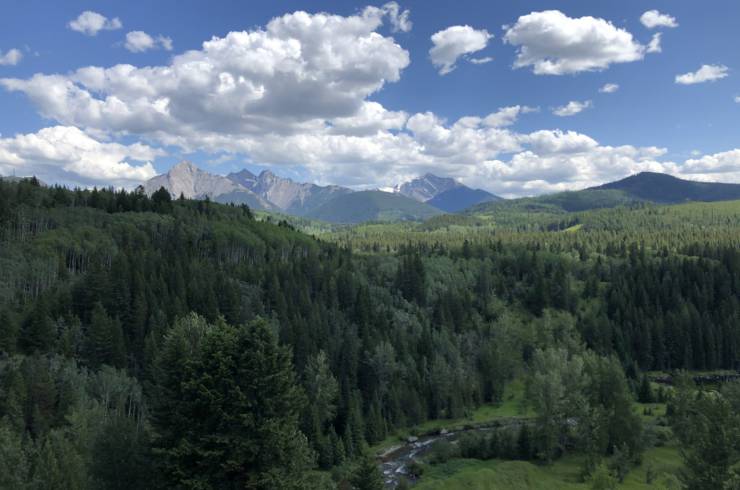


Almost all of B.C.’s Rocky Mountain Bighorn Sheep dwell in the mountains of the East Kootenay region, between Kicking Horse River and the U.S. border.
Approximately 3,000 Rocky Mountain Bighorn Sheep live in our province, building seasonal home ranges in a variety of habitats — from rocky outcrops and talus slopes, to meadows and grasslands, and coniferous or deciduous forests.
An adult Rocky Mountain Bighorn Sheep usually weighs between 110 and 290 lbs. They sustain themselves foraging on low-lying grasses, herbs, and shrubs, and when these are in short supply, the sheep will sometimes munch on conifers.
Scientific name: Ovis canadensis canadensis (Rocky Mountain ecotype of Bighorn Sheep)
Indigenous names: Kwiⱡqⱡi (Ktunaxa) | Sweláps (Secwépemc) | Yilíkʷlxkn (Syilx)
Status: Species of Special Concern (COSEWIC, SARA, & BC CDC)
Mineral licks are ungulates’
‘elixir of life’
Mineral or salt licks are essential to preventing all ungulates from becoming malnourished, and Bighorn Sheep are no exception. In nature, licks are typically formed from wet, muddy, spring-fed areas where mineralized water or soil is consumed, but as road networks grow around and through their habitat, Bighorns frequently take to paved roads to regulate their mineral intake.

A Bighorn herd disturbed while scouring the highway for salt.
Rocky Mountain Bighorn Sheep have strong ties to their home mountains
Studies have shown that Bighorns retain high fidelity to their home ranges— typically returning every year to the same selected territories. Some Bighorn Sheep even spend their entire lives on one mountain. Their seasonal ranges can be next to one another, or as far as 50 kilometres apart.

Human impacts on Bighorn populations
Bighorn populations are suffering significant decline. Increasing areas of their habitat are being developed for residential, agricultural, and industrial purposes. Even back in 2004, the BC government assessed that less than 50% of historically suitable Bighorn Sheep habitat remains — mostly due to resource roads, changes from forestry, competition with livestock, and human disturbance.

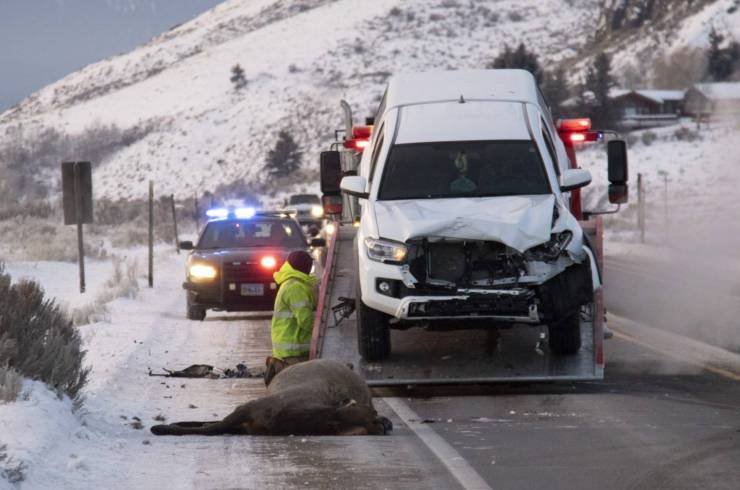
Over the past 20 years, more than 200 Bighorn Sheep have died on the highway near Radium alone.
Salt used for road maintenance can attract and hold sheep in highway corridors. The Mile Hill south of Radium has been a high-risk stretch of road for motorists and wildlife alike, with 200 Bighorn deaths over the past two decades. Wildsight has long advocated for infrastructure such as wildlife overpasses, exclusion fencing, and ungulate guards to protect both wildlife and motorists in the area. In 2026, Wildsight and partners announced the completion of the Radium Overpass on Mile Hill — a huge win for people and wildlife alike. Still, much more infrastructure work remains to be done in the region with regards to protecting Bighorns and other species from our highways (see our Reconnecting the Rockies project).
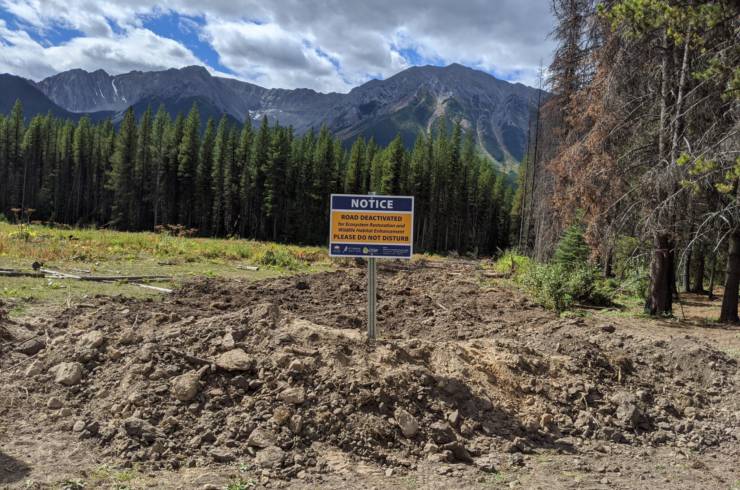
Aside from luring Bighorn Sheep to some of our most treacherous highways, road-building disrupts habitat connectivity — fracturing home ranges and making travel between seasonal territories dangerous. Resource roads also provide access for hunters to target the species with greater ease.
Close contact with domestic sheep is wiping out Bighorn Sheep herds
With less and less suitable habitat available, Bighorn Sheep have been forced to live increasingly close to human settlements, many of which contain livestock — something that has proven to be a death sentence for our Bighorn Sheep.
Not only does livestock ranging lead to range depletion and resource competition for Bighorns — it has led to the transmission of a deadly disease that is wreaking havoc on their populations. In the 1980s, Bighorn Sheep began to be infected with Mycoplasma Ovipneumoniae (M. Ovi) after interacting with domestic sheep. Although the disease can be asymptomatic in domestic sheep, in Bighorn Sheep the bacteria colonizes their lungs, frequently leading to fatal bacterial pneumonia in otherwise completely healthy animals.

Zoonotic illness transmitted by domestic livestock has led to mass die-offs in Bighorn Sheep populations. Pneumonia outbreaks (caused bi M.Ovi or other transmissible pathogens) frequently result in 75-100% herd mortality. For example, the Galton herd, which lives south of Fernie, was decimated by M.ovi. It currently has about 13 members — 5% of its pre-illness size. Even when herd members survive the disease, the years following an outbreak result in a large decline in lamb recruitment.
Outdoor recreation
Like many herd animals, Bighorn Sheep are a cautious, sensitive species — perpetually scanning for threats. This means that disturbances from snowmobiles, helicopters, ATVs, vehicles, as well as non-motorized recreation can cause significant stress to these animals. Chronic stress has been proven to lead to poor health, reduced growth, and reduced reproductive fitness in Bighorn Sheep. (Geist 1979).
What is Wildsight doing?

- Wildsight Invermere’s ‘Rocky Mountain Bighorn Sheep Conservation & Biodiversity Program’ monitors and collects data on Bighorn Sheep herds near Radium. This provides valuable insights into migration patterns, spatial movements, and overall well-being. This information is essential for developing effective conservation strategies and management plans that will ensure the long-term survival of the Bighorn Sheep population.
- In Kicking Horse Canyon, invasive burdock is proliferating in a Bighorn Sheep herd’s prime wintering grounds. Burdock’s ‘burrs’ become tangled in the sheep’s thick winter coats, which reduces their insulation and decreases their ability to survive harsh winters. Over the past two years, Wildsight’s Youth Climate Corps has removed burdock plants and seed heads from the area with great success. Fewer sheep are covered in burrs, giving them a better chance to thrive through the winter and successfully birth lambs in the spring.