

Restoring habitat. Supporting recovery. Working together.
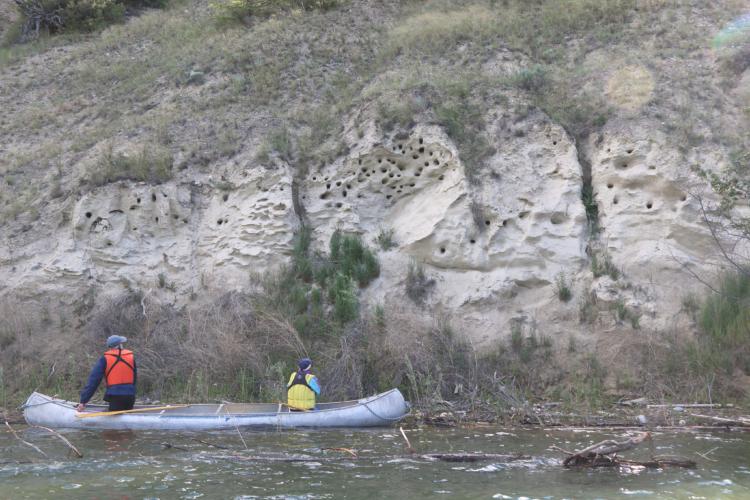
Swallows are a familiar part of summer in the Columbia Valley — but they are also part of a group of birds known as aerial insectivores, which are experiencing some of the steepest population declines in Canada.
The Upper Columbia Swallow Habitat Enhancement Project (UCSHEP) is a six-year initiative (2021–2026) which aims to help reverse these declines through habitat restoration, research, and community action.
Across the region between Canal Flats and Donald we are working to restore nesting habitat, support breeding success, and better understand how to conserve these species long-term.
Why swallows need help
Bank and Barn Swallows are aerial insectivores — birds that feed on flying insects — and their populations have dropped sharply due to threats such as:
- Loss of nesting habitat
- Changes in land use and building design
- Declines in insect populations
- Disturbance at breeding sites
- Climate Change
In Canada, Bank Swallows have experienced some of the steepest population declines of any bird species, making conservation action urgent. Some of the most significant drivers of population change may be occurring outside of their breeding range, during migration or in wintering areas.

What we’re doing
UCSHEP takes a hands-on, science-based approach to conservation:
Restoring and creating habitat
- Re-shaping banks to create vertical nesting faces for Bank Swallows
- Installing artificial nesting structures and nest cups for Barn Swallows
- Building innovative artificial Bank Swallow habitat where natural sites are limited
- Restoring degraded sites and stabilizing conditions to support long-term use
These actions directly increase the availability of safe, suitable nesting habitat across the Upper Columbia.
Tracking and research
- Installed Motus Wildlife Tracking stations across the region
- Tagged 100 Bank Swallows to understand migration and post-breeding movements
- Collected detailed monitoring data to inform conservation decisions
This work has helped fill critical knowledge gaps and supports Bank Swallow conservation beyond the Columbia Valley.
Monitoring populations
- 128 active Bank Swallow colonies identified between Canal Flats and Donald (only ~30 had been previously documented through the Kootenay Bank Swallow Project (prior to 2020)
- Over 1,800 barn swallow nests (active and inactive) were documented in our study area (Canal Flats to Donald); 695 of those were active nests we monitored.
- Long-term monitoring occurs at natural, enhanced and restored sites
All data contributes to provincial and federal efforts to identify and protect Critical Habitat.
Community and partnerships
This work is driven by collaboration:
- Nearly 170 volunteers contributing to monitoring and data collection
- Partnerships with government, NGOs, and local landowners
- Collaboration with Indigenous Nations to support conservation on their lands
Community involvement and collaboration has been essential to scaling this work across the valley.
More information on achievements and the project are found in the 2026 FWCP Final Report.


Conservation in action
UCSHEP is delivering real, measurable results. For example, at one enhanced site in Athalmer, reshaping a soil mound into suitable Bank Swallow nesting habitat resulted in:
- ~400 nesting burrows created
- ~200 active nests in a single season
- An estimated ~800 chicks produced in one year.
This kind of targeted habitat restoration shows how quickly swallows can respond when the right conditions are created.
Driving conservation at a larger scale
The impact of UCSHEP extends beyond individual sites.
Project data has:
- Helped identify the foreshores of Columbia Lake and Lake Windermere as Critical Habitat for Bank Swallows
- Contributed to the proposed Upper Columbia Key Biodiversity Area (KBA)
- Supported regional and national recovery efforts for both species
Looking ahead
Our work isn’t finished yet.
We are continuing to build on this momentum, with the help of our volunteer surveyors, by:
- Monitoring our 29 enhancement sites to track long-term success
- Continuing with long-term monitoring of 60+ Bank Swallow colonies in the Lake Windermere and Columbia Lake areas
Why this work matters
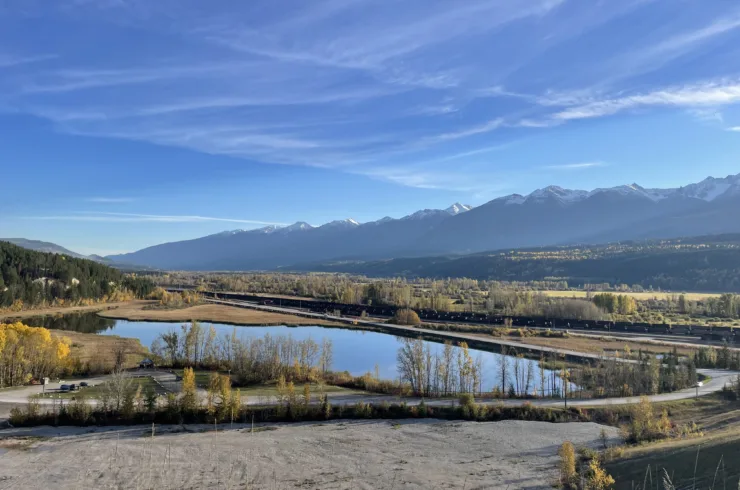
The Columbia Wetlands — one of the largest intact wetland systems in North America — provides critical habitat for swallows and other aerial insectivores, a group of birds experiencing some of the steepest population declines in Canada.
By restoring nesting habitat for Bank and Barn Swallows, we are helping support these species where they need it most — while contributing to the broader recovery of aerial insectivores and the health of wetland ecosystems they depend on.
For more information on the UCSHEP, please contact project biologist, racheldarvill@gmail.com. If you are interested in becoming involved with this swallow conservation project, please contact swallows@wildsight.ca.
The project would not be possible without the generous financial contributions of the Columbia Basin Trust, Fish and Wildlife Compensation Program, Regional District of East Kootenay’s Columbia Valley Local Conservation Fund, Province of BC’s Gaming Grant, and BC Parks.
Donate to support this project




Further Reading:
How a pile of dirt became a bank swallow haven (Sept 2024)
To learn about how to coexist with Barn Swallows: Strategies for Reducing Messy Nests and Coexisting with Swallows and How to Attract and Host Barn Swallows
To view our swallow conservation brochure for the Columbia Valley, click here. Updated December 2022.
Click here for the article in Canadian Wildlife Magazine (May 2022) featuring the Upper Columbia Swallow Habitat Enhancement Project: Canadian Wildlife article-May/Jun 2022 -Barn Swallows.
Thanks to EcoFriendly West for publishing this 2022 story regarding some of the conservation successes (thus far) on the Upper Columbia Swallow Habitat Enhancement Project!
Press Release: Motus Network Established in the Columbia Valley in 2022 Used to Track Bank Swallows
Press Release: PR Barn Swallows Re-use their Nests (2022)
Press Release: PR Swallow Achievements in 2022
Details on the 2024-25 project (year 4) can be found in this final report.
Details on the 2023-24 project (year 3) can be found in this final report.
Details on the 2022-23 project (year 2) can be found in this final report and in this short video:
This short video is from year 1 (2021-2022) of our project:
This project was developed and is managed by Goldeneye Ecological Services and administered by Wildsight Golden. 
We would like to acknowledge financial and in-kind contributions from the following organizations:

All photos on this webpage by Rachel Darvill