

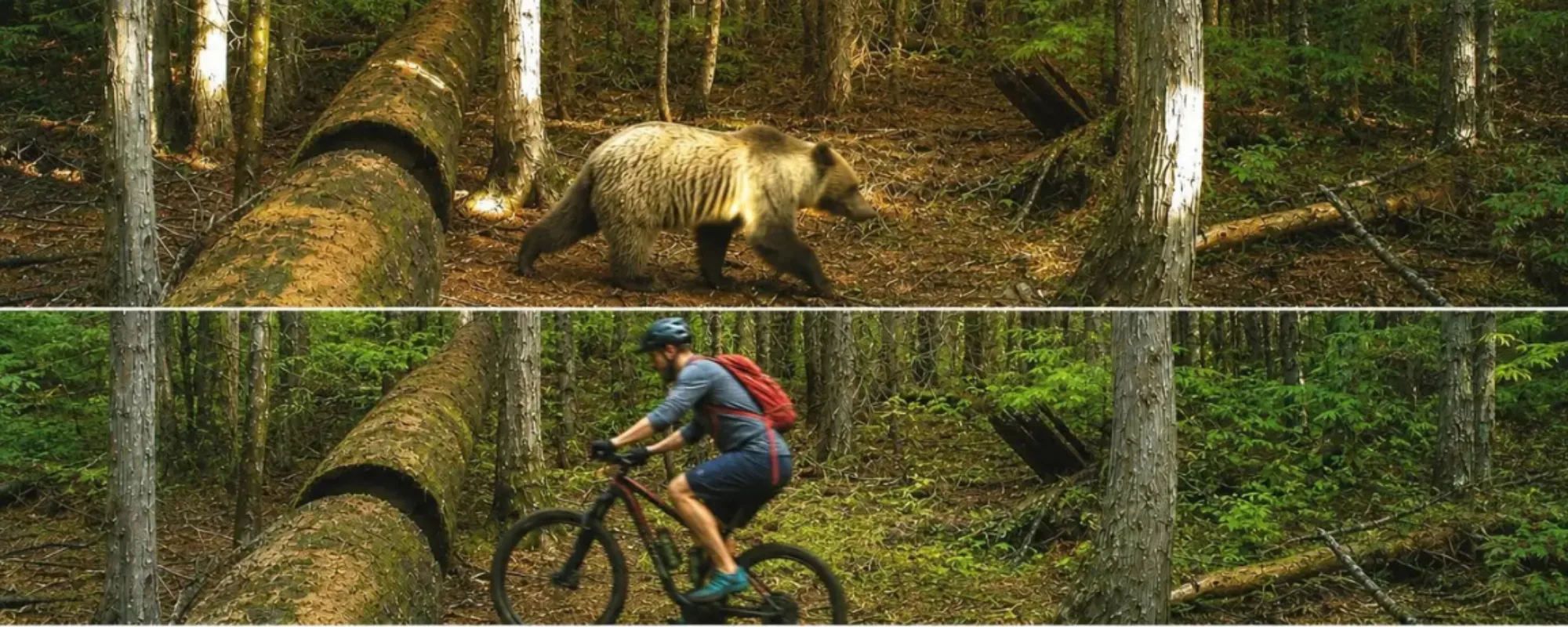
From hiking and trail running to mountain biking, spending time outdoors is good for us. It connects us to nature, improves our health, and often inspires people to care more deeply about the landscapes around them. As outdoor recreation increases in our mountain communities, an important question arises: how do the animals that live here respond to sharing those same trails?
According to Kootenay-based wildlife biologist Clayton Lamb, there isn’t a simple answer.
We chatted with Lamb about his latest research examining how recreation trails influence the movements and behaviour of large mammals around the trail network near Fernie. His study reveals that while some species can adapt by changing where or when they are active, others—particularly Elk and Grizzly Bears—tend to avoid heavily used trails altogether.
One of the biggest takeaways? We can’t paint all wildlife with the same brush. Different species simply respond in very different ways to people on the landscape.

“I was surprised that the detection rates of most wildlife and their daily patterns were not that dramatically different between a mountain bike trail in Fernie that can see a few hundred people a day, and an adjacent wildlife trail out in the bush,” says Lamb. “Even with the intense use that you see from people on those trails, you can see the wildlife react, but it’s not as if they completely avoid when people are out there. It’s not as stark as I would have thought.”
That doesn’t mean recreation has no impact. Rather, the study suggests wildlife adapt in different ways depending on the species—and understanding those differences is key to helping people and wildlife coexist.
Not all wildlife responds the same
Elk stood out as the species most affected by recreation.
“Elk were definitely the species that had the most consistently negative responses,” Lamb explains. Compared to areas with fewer trails, Elk appeared less frequently throughout the recreation network. Within that network, they also avoided the busiest trails and were least likely to be present during the daytime, when people were most active.
That finding wasn’t entirely unexpected. Previous research has consistently shown Elk are particularly sensitive to human disturbance, whether from recreation, hunting pressure, or other human activity.
Black Bears, however, told a very different story.
“They were sort of indifferent,” says Lamb. “They were detected at similar rates regardless of whether they were on a recreation trail, a wildlife trail, within the trail network or somewhere completely unaffected by high levels of recreation.”
Unlike Elk, Black Bears showed little change in where or when they used the landscape, regardless of how busy the trails were.
Lamb’s team found that Grizzlies generally avoided spending prolonged time in recreation areas, but they didn’t avoid them altogether. GPS collar data showed bears still travelled through these areas—they simply moved through them quickly, usually at night.
“They didn’t like the recreation area but they still went through it,” Lamb says. “And when they do go through, they actually prefer to use the mountain bike trails specifically — probably because they’re the best trails possible that can facilitate them getting through quickly.”
It’s a reminder that an animal using a trail doesn’t necessarily mean it’s comfortable being there. Sometimes it’s simply the most efficient route through a potentially hazardous area.
Why do Grizzlies and Black bears behave so differently? Lamb suspects the answer lies in how we treat them as species.
“Black bears, in general, get a bit more grace in town. (I mean, to some degree, the province also has a 100% kill policy on them once they get into trouble and are captured, so they don’t get that much grace.) But, it’s not uncommon for mountain towns to have a black bear walking down the street. But you don’t see this with Grizzly Bears, because somebody’s going to call the conservation officer STAT.”
Essentially, our tolerance for close encounters with Black Bears is much higher than with Grizzlies — which allows Black Bears to become a bit more habituated.

If we can share time, we can share space
Lamb doesn’t think recreationists need to make huge modifications to their practices — but there is one easy way to help improve coexistence with wildlife on trails.
“I think trying to find that happy medium between people and wildlife—we want people to be out there recreating too. I definitely don’t buy into this narrative of ‘we need people off the landscape.’ But there are ways we can take steps to manage our impact.”
One of the simplest ways is to think about when we recreate.
The study found that dawn and dusk are especially important periods for wildlife. Unfortunately, those cooler hours are also some of the most popular times for people to head outside, particularly during summer.
“Those shoulders, especially in the summer, on either side of that 9am-to-7pm window, are really important,” Lamb says. “That’s when a lot of wildlife is most active.”
Whenever possible, choosing to recreate a little later in the morning or earlier in the afternoon—or opting for an in-town walk or ride instead of a backcountry trail during dawn or dusk—can give wildlife a little more space.
“It’s not as if as soon as you go for a run at 7:30 you’re a terrible human being,” Lamb laughs. “It’s more that people should just know there are these small negative effects that do accrue.”
Of course, avoiding dawn and dusk isn’t always possible. Work schedules, hot weather, and busy lives mean sometimes it’s the only window where people can get outside. In this case, it’s important to be extra prepared.
If you’re recreating during those hours, be wildlife-ready, and carry bear spray.
Planning for coexistence
The findings also offer lessons for land-use planners.
Rather than expanding trail networks deeper into undisturbed habitat, Lamb suggests making use of areas where wildlife is already adapting to existing human infrastructure, such as near towns or highways.
“There are these spaces that we’ve already had an impact on,” he explains. “Whereas if you plunk that trail network into a totally wild place, it would have a greater effect.”
Keeping recreation infrastructure close to existing development can help limit the spread of disturbance into intact habitat while still providing excellent opportunities for people to get outside.
Ultimately, Lamb’s research suggests that successful coexistence depends on understanding that various species experience our presence differently. The more we understand that nuance—and make thoughtful choices about where and when we recreate—the better chance we have of peacefully sharing these landscapes with the wildlife that calls them home.
