


We returned to Redrock during a thunderstorm. As we drove up the muddy logging road, it began to drizzle slightly; by the time we returned to our cars an hour later it was a full on downpour.
The weather matched the occasion; thunder cracked as I stared down at an unrecognizable landscape in what should be the heart of the Inland Temperate Rainforest, 150km north of Revelstoke near Mica Dam. Exactly a year ago I had stood in this same spot looking at an ancient forest full of large Cedar and Hemlock, surrounded by dense beds of Devil’s Club and ferns, while recording bird calls on my Merlin app.

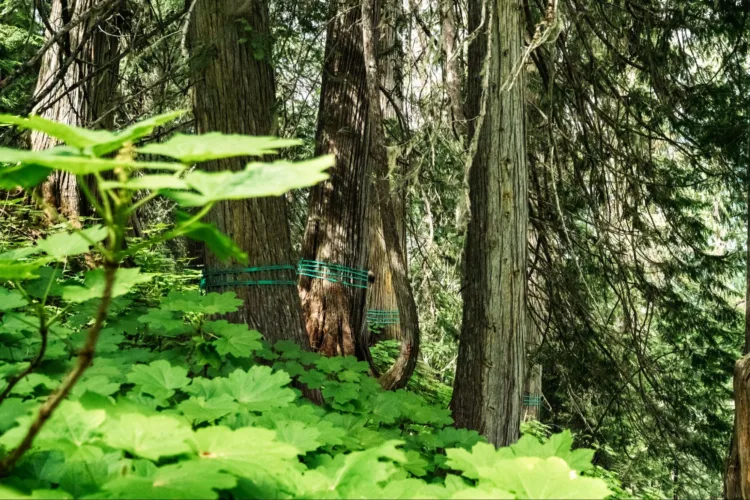
Last year we knew what was coming — that these trees were slated to be logged. In 2025, the remaining patch of forest was already surrounded by clearcuts where massive trees had once stood. Carstraps around the largest trees in the patch were a clear indicator that it was only a matter of time before these ancient giants were felled too.
But it was still a shock. It’s hard to describe the feeling, seeing something so magnificent reduced to mud, stumps and broken brush. Everything felt small and monochromatic, like the vibrancy of thousands of years of life had been sucked from the land.

The visit was not long as — without the shelter of the ancient trees — we were quickly soaked, feeling exposed as thunder rolled around us. Heading back to the cars, the logging road passed through a thin strip of forest. This is all that remains of the old growth deferral.

Old growth deferrals were implemented in the Kootenay Boundary region in 2021 as a temporary measure until the recommendations from the Old Growth Strategic Review could be fully implemented. Nearly six years later, we are still waiting and demanding that the provincial government meaningfully implement the review’s recommendations.
The old-growth deferrals have temporarily protected a lot of amazing forest from logging in our region, but in places like north of Revelstoke they’ve also missed a lot of irreplaceable old forest by using old datasets from 1997. If the deferrals were re-run today in the Revelstoke area using the latest datasets, a forest like this block in the Redrock area would likely be protected.
Current provincial and Kootenay Boundary regional guidance does not require licensees to look for exceptional and irreplaceable old growth that was missed in the original mapping when they develop cutting permits and blocks. While there is a process to remove a deferral and replace it with a new deferral elsewhere, no process exists to add in areas missed by the deferrals.

This area of Redrock is a prime example: logging company Stella-Jones clearcut ancient forest and left only a small isolated stand (the provincially-identified deferral), fragmented in the middle by a road. The company also has adjacent blocks being proposed for logging that contain spectacular old-growth forests — the proposal will see 250 hectares of new logging in provincially defined core caribou habitat, much of which is old forest.

Standing in the same spot, one year apart. Above photo: Bailey Repp. Below photo: Matt Timmins.

Communities like Revelstoke recognize the importance of old growth, as demonstrated by the Southern Interior Local Governments Associations resolution that was passed earlier this year. Harvesting 1,000 year old trees is not a sustainable practice, and these few remaining pockets of ancient forest provide much more for us standing by safeguarding biodiversity, supporting cultural values, reducing flood and fire risk, and storing large amounts of carbon in the trees and soil that, if logged, are then released into the atmosphere.
Yet standing in the middle of an ancient forest clearcut, it is clear that provincial policy is failing us, and the voices of First Nations and local communities are continuing to be ignored. I urge you to add your voice to the cause and let the provincial government know that protecting old and ancient forests is a priority for BC residents.
