

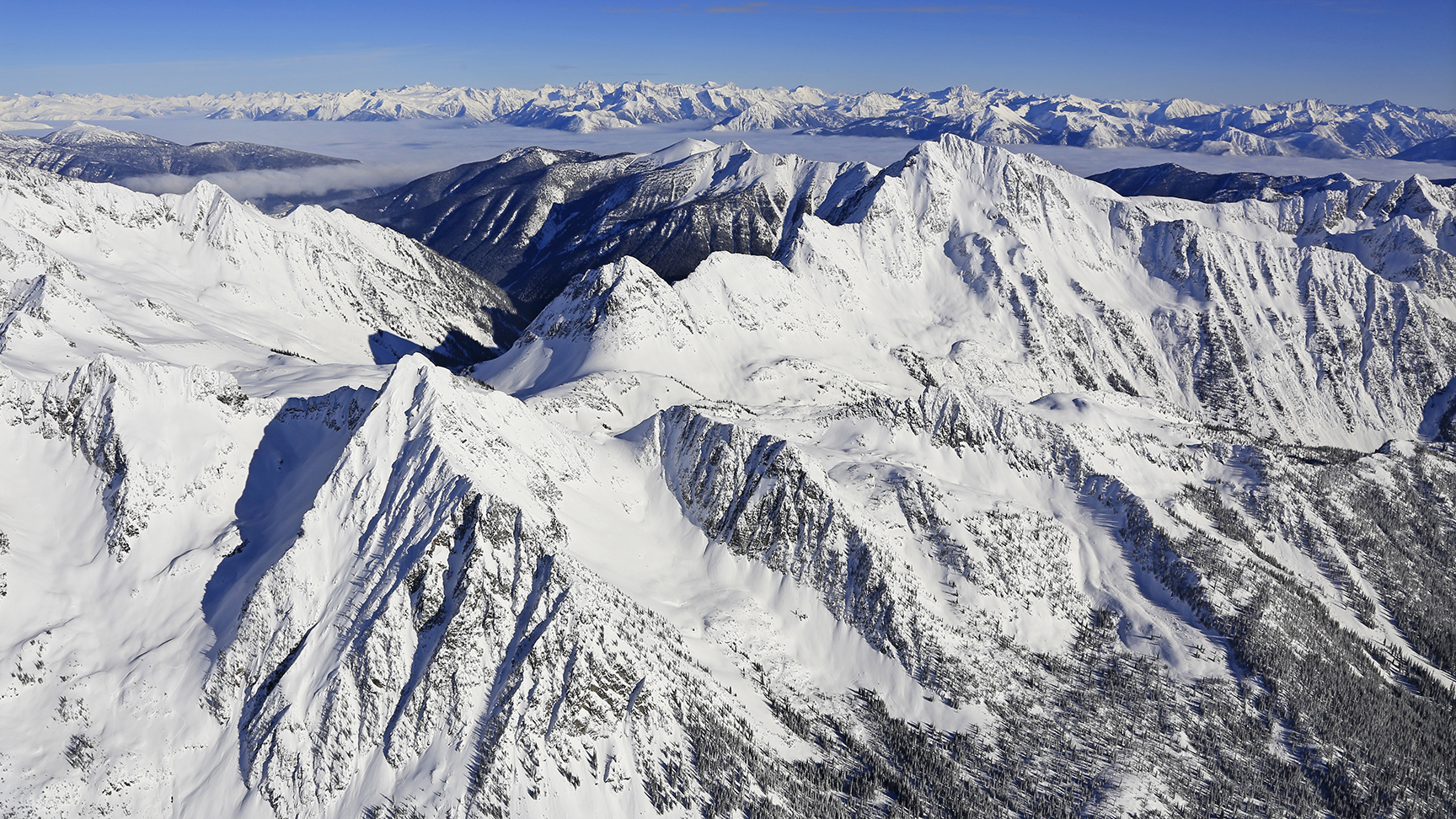
Wildsight filed a petition in the BC Supreme Court on Friday seeking a judicial review of the provincial government’s decision not to require an environmental assessment for the proposed Zincton Resort in the central Selkirk Mountains, east of New Denver.
The controversial 5,500-hectare development would convert critical connectivity habitat for grizzly bears and wolverines into a hybrid lift-serviced, backcountry ski resort, with an accompanying resort village on adjacent private land.
In July, the province determined that Zincton didn’t require an environmental assessment, stating that BC’s Mountain Resorts Branch (MRB) could adequately assess the resort’s impacts.
Wildsight’s petition, filed by Nogala Law Group LLP and Columbia Valley Law Corporation, argues that the province’s decision not to require an environmental assessment for Zincton was unreasonable, and should be overturned.
“The province’s decision was based largely on the premise that a formal environmental assessment wouldn’t achieve anything additional to what the Mountain Resorts Branch’s review would achieve,” says Ian Moore, Partner at Nogala Law Group LLP.
“But these two processes are not equivalent: an environmental assessment is, by law, required to evaluate effects that the MRB need not consider in the same way or to the same extent, including impacts to Indigenous rights, cumulative effects and biodiversity thresholds.”

A problematic policy
Under BC’s current legislation, all-season resorts like Zincton only automatically require an environmental assessment if they have 2,000 beds or more. With potentially fewer than 1,700 beds, the proposed Zincton Resort falls below that threshold.
In 2023 and 2024, both Wildsight and the Sinixt Confederacy asked the then Minister of Environment and Climate Change Strategy to require that the project undergo an environmental assessment anyway. But the province ultimately rejected these requests in its July decision.
“It is ludicrous that the factor that determines whether a proposed development needs an environmental assessment is the number of beds it contains, rather than its footprint and potential impacts on land, water and wildlife,” says Robyn Duncan, Wildsight Executive Director.
“That the government would deem a project of this size not large enough or consequential enough on its own is shocking, but given the demonstrated impacts to wildlife, water and Indigenous rights, it’s incomprehensible.”

Zincton’s impact on wildlife and Indigenous rights
Located between four provincial parks, the proposed Zincton Resort would bring a year-round stream of traffic and people into important habitat for mountain goats, grizzly bears and wolverines.
It’s estimated that only 30 grizzly bears remain south of Highway 31A. If Zincton proceeds, it would isolate that population from larger populations to the north, which could contribute to local extinctions over time.
Independent ecologist Michael Proctor was recently quoted as saying: “Ski areas aren’t inherently bad. The issue for me is it’s right smack dab in the middle of what is probably the only viable corridor to this population [of grizzly bears].”
The proposed Zincton tenure also includes abundant huckleberry patches, making it high-value habitat for grizzly bears.

The resort would similarly fragment wolverine populations in Kokanee Glacier and Goat Range provincial parks. This area contains the highest confirmed wolverine density in the region, connects important denning areas, and contains habitat qualities that are preferred by sensitive breeding females.
Research by the Ktunaxa Nation and others has underscored the importance of not considering this proposed development in isolation, given the landscape is already under intense pressure from increased human activity and climate change.
The study urges that we review proposed developments in this region through a cumulative effects framework, and that we consider recreational impacts as an industrial use. If Zincton were developed, it could exceed the landscape’s carrying capacity, threatening not just wildlife but also Ktunaxa cultural values.
Should Wildsight’s petition succeed in forcing a review of the Environmental Assessment Office’s decision, it could set a precedent for when and how future all-season resorts are evaluated — but this court case comes with costs.
Support legal action for the wild
This judicial review could cost up to $30,000. Thanks to support from West Coast Environmental Law’s Environmental Dispute Resolution Fund, part of this is covered — but we need to raise at least $15,000 to cover the gap.
Will you chip in to ensure Zincton Resort gets the scrutiny it deserves?