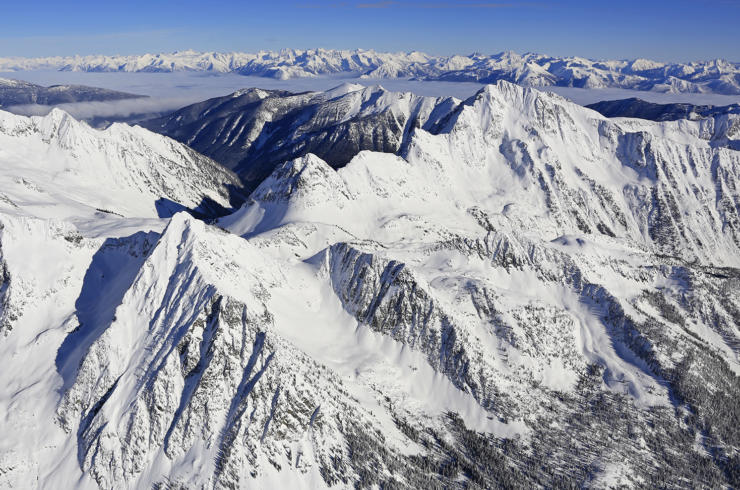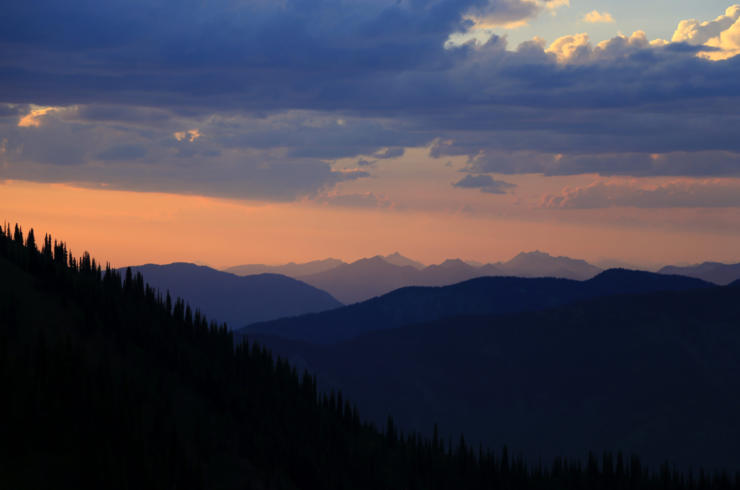


In late November, Wildsight launched a legal challenge over the B.C. Environmental Assessment Office’s decision not to require an environmental assessment for the proposed Zincton Resort, east of New Denver. Since then, online debate has intensified and there has been discussion around the idea that the resort would facilitate the remediation and clean-up of local ‘lead-contaminated’ rivers.
Let’s take a closer look.
Separating fact from hyperbole
The proposed Zincton tenure sits in a historic mining district where the geology is dominated by rocks rich in lead, zinc, gold and silver. For over a century these minerals have been mined in the area, and natural weathering of exposed rock has contributed to the presence of metals in sediments across the watershed.
Amid this context, Zincton claims the area’s rivers are “fully contaminated” with “extra-strength lead” that is poisoning local wildlife like grizzly bears.
The proponent implies that approving the Zincton Resort is the only way to clean up this contamination, claiming it will redirect a proportion of its profits towards remediation efforts. The choice is framed as: approve the resort or condemn the environment and the wildlife that depend on it.

What are the lead-contamination claims based on?
Before we begin to untangle whether or not these claims are true, it’s important to understand where they stem from. Zincton has had an ‘Environmental Overview’, which was prepared for the resort’s proponent by Whistler-based Cascade Environmental, a consultant hired by the proponent.
The purpose of an environmental overview is to begin to identify potential environmental considerations and impacts related to a proponent’s application. Zincton’s environmental overview report relied on existing data already in the provincial database. It didn’t require independent verification, and it is not bound by legal standards. The proponent determines what is included, what is omitted, and how results are presented.

Sediment data ≠ water quality data
The question at hand is whether metals are currently polluting waterways in the Zincton area as a result of contamination from mine sites, and whether this is affecting aquatic and terrestrial life.
As rocks naturally break down (through weathering and other processes), metals can build up in sediments such as soil, sand, and silt on stream beds. On their own, these metal-rich sediments aren’t necessarily a problem. They only become a concern if those metals dissolve into the water at high concentrations.
Zincton’s environmental overview was based on provincial stream sediment samples, and did not include any water samples. Sediment samples are useful for looking at historic and long-term accumulation of pollutants. Water samples detect pollutants that are currently in the water. Attempting to draw concrete conclusions about water quality based only on one or the other ignores half the picture. Anyone wishing to make scientifically sound claims about water quality in the Zincton area should also look at the water itself.
What we found when we sampled Zincton’s water
In fall 2024, Wildsight took eight water samples from five creeks and waterways near Zincton, including Whitewater, Goat and Kane Creek. You can view our results here. To be clear, this was not a formally designed water testing program akin to what would be required as part of an environmental assessment. Our aim was to collect representative samples from major mine-influenced and non-mine-influenced waterways to get a snapshot of water quality in the area.
All but one of our samples met BC’s water quality guidelines for drinking water and aquatic life. (Guidelines for aquatic life are typically stricter than those for drinking water, because contaminants can build up in food chains). The only sample that exceeded the guidelines (for arsenic, copper, zinc and silver) was taken upstream of an old mine site and served as a control for a sample taken downstream. The downstream sample had elevated levels of zinc, but was otherwise within safe limits for all other metals.
Wildsight’s results contradict the proponent’s public rhetoric, but they’re actually fairly consistent with Zincton’s own environmental overview. The report states: “high concentrations of elements which exceed the water quality guidelines were also detected upstream of all known past producing mines on Kane Creek… this may indicate that the elements precipitate out into the sediment and do not stay suspended in the water column.”

Disturbing sediment could risk more harm than good
Together, these results suggest that leftover mine waste is not necessarily the source of any pollution in the area. In fact, unless disturbed, metals appear to remain bound in sediments rather than dissolving into the water.
Disturbing these sediments — either through construction of the resort village or efforts to ‘remediate’ the area — could cause more harm than good.
Further research, including identifying areas with high concentrations of metals in the earth, sediment transport regimes, and geomorphology characteristics, would help to properly estimate these risks — but these studies are unlikely to take place without an environmental assessment.
Conclusion
The evidence does not support claims that these creeks pose a threat to wildlife and people, but it does suggest that disturbing these waterways might create new problems. The bottom line is that more research is needed, and an environmental assessment would allow that research to occur. Without this rigorous, transparent assessment, taxpayers could be exposed to long-term costs — from habitat loss and species decline, to downstream water quality issues.
Environmental assessments exist precisely to ensure complex projects are carefully studied before impacts occur — protecting ecosystems, communities, Indigenous rights, and taxpayers alike. Supporting due diligence is not distraction; it’s responsible governance.
The reality is that a 5,500-hectare resort, with the capacity to comfortably host 1,300 skiers a day, is not a small project in a mountain ecosystem as sensitive as the one in which Zincton is proposed, and it shouldn’t be treated as such.